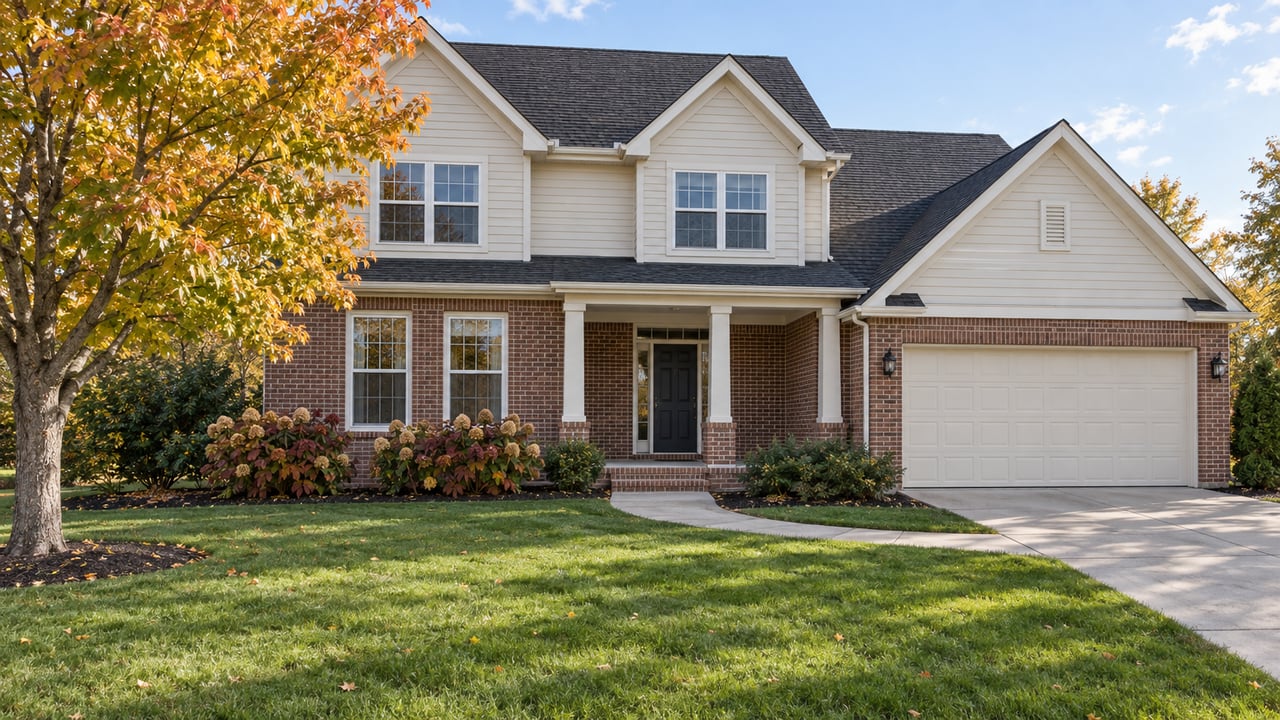
"Up to $25,000 incentive is valid on firm, non-contingent purchase agreements." That line sits in the footnote of the Drees Homes Spice Up Your Home sales event. It is the most important sentence for anyone weighing a new build against a resale in Westfield this fall.
Non-contingent means the purchase can't depend on selling the home you live in now. The offer comes with a 2-1 rate buydown, a deadline and a lender requirement. Taken together, these terms describe one kind of buyer: someone with no house to sell, a loan type the buydown accepts, and room to close before the holidays. Everyone else, including the Westfield family moving up from its first house, is shopping in a different market, even when the houses sit a mile apart.
The Four Conditions in the Fine Print
The Drees offer applies to agreements accepted in select Indianapolis-area communities between October 1 and November 22, 2026. It covers quick move-in homes and select build-to-order floor plans. The promotion's terms attach these four conditions, and not every one applies to every purchase:
- Sign a firm, non-contingent purchase agreement. This applies to the incentive generally. The amount varies by community and floor plan.
- Finance with First Equity Mortgage, the builder's own lending subsidiary. Buyers can purchase a Drees home with any lender, but they must use First Equity to get the incentive and the promotional rate.
- Close by December 22, 2026, if the home is a quick move-in.
- Avoid government and adjustable-rate loans if you want the 2-1 buydown, which is offered on quick move-in homes. The terms say those loan types aren't eligible, and that jumbo loans get the buydown at a different rate.
The terms also exclude homes from the Elevate by Drees Homes division, and the offer can't be combined with other promotions.
Each condition filters out a group of buyers. A move-up family that wants its purchase to depend on selling its current home doesn't meet the first. An FHA or VA borrower can't use the buydown. A quick move-in buyer whose current lease or sale timeline runs past late December runs into the third. The incentive is real, but it is aimed at a narrow slice of the market.
Why the "Reset" Rate Matters More Than the Teaser
The headline number is 5.125% for the first year. The longer-term number tells you more about the market. Under the Drees terms, the rate rises to 6.125% in year two and then stays at a locked 7.125% for years 3 through 30. The promotion shows a 7.219% APR at every step.
Compare that with Freddie Mac's Primary Mortgage Market Survey, where the 30-year fixed rate averaged 7.40% for the week ending October 15, 2026. A year earlier it was 6.27%. The rate a Drees buyer settles into for the last 28 years is below the national weekly average. In practice, the builder is subsidizing the loan for its full term, not just the first two years. And with rates more than a point higher than last October, the builder can win more buyers by paying down the rate than by cutting the price.
The builder's own example uses a $700,000 home, a 760 credit score and 20% down, which works out to a $560,000 loan. Standard amortization math, principal and interest only and rounded, shows how the schedule plays out against the market average:
| Period | Rate | Approx. monthly principal and interest on $560,000 |
|---|---|---|
| Year 1 | 5.125% | about $3,050 |
| Year 2 | 6.125% | about $3,400 |
| Years 3–30 | 7.125% | about $3,770 |
| Freddie Mac 30-year average, week ending Oct. 15, 2026 | 7.40% | about $3,880 |
Your actual payment will depend on taxes, insurance and the lender's final terms. The point of the table is the bottom two rows. A buyer who qualifies keeps roughly a $100-a-month edge for decades after the first two years. A resale seller can't offer that, because a seller-paid concession to the buyer's lender has to come out of the seller's own proceeds.
Builders Are Discounting What's Already Built
Rate subsidies are half of the picture. The other half is that builders have finished homes on the ground, and the December closing deadline makes those homes cost money every week they sit. Here is what the builder pages showed in October:
- Pulte, Towns at Union. A Jayton plan at 1783 Gualandri Lane was listed as available now at $394,990, down from $421,530, which Pulte labels $26,540 in savings.
- Pulte, Lancaster Townhomes. Priced from $316,000, and Pulte says the community is offering quick move-in homes only.
- Drees, Belle Crest and Carramore. Three quick move-ins were listed across the Belle Crest townhomes and Carramore single-family community, from $374,900 to $769,900.
- Arbor Homes, Orchard View. The community is west of US 31 and north of SR 32 and offers quick move-in ranch homes. Arbor's Westfield page also advertises FHA rates as low as 5.49%, at a 6.372% APR, through Silverton Mortgage.
The Arbor offer fills the gap the Drees terms leave. Drees excludes government loans from its buydown, and Arbor advertises one. So even the builder incentives sort buyers by loan type. A Westfield buyer's first question is which offers they qualify for, before they get to which house they like. Builder prices and promotions change without notice, and the Drees terms say so directly, so any of these figures may have moved by the time you read this.
Where That Leaves the Resale Market
The Indiana Association of REALTORS September 2026 report for Hamilton County shows a resale market that is slowing down without loosening much. For all residential sales in September 2026:
- The median sale price was $465,000, up 1% from September 2025.
- Median days from listing to pending was 29, up 53% year over year and 61% from August.
- Months of inventory stood at 2.2.
- Closed sales totaled 547, up 4%.
Across MIBOR's 17-county central Indiana area, September 2026 data showed 2.9 months of supply, up from 2.4 a year earlier, with single-family inventory up 16.3%. MIBOR CEO Shelley Specchio described the region as moving "toward a more balanced market" and added that "homes that are priced right are still attracting serious buyers."
Read alongside the builder terms, these numbers point to a split market. Hamilton County's supply is tighter than the region's, so resale prices are holding. But homes are taking noticeably longer to go under contract, and the buyers with the most flexibility are being offered subsidized rates and discounted finished homes elsewhere. Resale sellers end up competing hardest in the group the builder deals leave out: buyers who have a home to sell.
For a Westfield seller, a contingent offer may be the most realistic offer on the table this fall. How the contingency is structured and timed becomes part of the price. A buyer with no home to sell has a builder making a strong pitch, and a resale home has to beat that pitch on location, lot or the house itself.
For a move-up family, it comes down to the calendar. A household that needs its sale proceeds to buy may find a non-contingent agreement hard to sign before that sale is settled, and how to sequence the two is a question for your lender and attorney. The Drees offer accepts agreements through November 22 and requires quick move-in closings by December 22. With the county's median listing-to-pending time at 29 days in September, selling first and buying inside that window is possible, but it leaves little room for anything to go wrong.
The Supply Still in the Pipeline
The current offers are about clearing homes that are already built. The next round of Westfield supply is still under review. Pulte's proposed Eagle West, reported by Current in Westfield, covers about 127 acres west of Eagletown Road and south of 186th Street near Grand Park. The proposal describes homes of 2,300 to 3,300 square feet priced from $450,000 to $600,000, with about 45 acres of open space. In August, Current reported that commissioners questioned the plan's density and the precedent it could set for development farther north and west. After a September workshop, Current reported that Pulte had cut the plan from 270 homes to 252, and that it could return for a vote in October.
The proposal is Advisory Plan Commission case 2608-PUD-10, covering 126.86 acres. It was not on the City Council's October 12 agenda. Beyond Eagle West, a Grand Park zoning district plan presented in April described 3,784 residential units within 8.3 million square feet of planned development, with 186th Street dividing the north and south districts. None of those homes will compete with resale listings this winter. Over the next few years, though, they will keep the builder pitch going for buyers with no home to sell.
Quick Answers
Does the Drees offer apply to every Westfield community?
No. The terms say the incentive applies in select Indianapolis-area communities, that the amount varies by community and floor plan, and that Elevate by Drees homes are excluded. The promotion page doesn't name the qualifying communities, so ask a Drees market manager whether Belle Crest or Carramore is included.
What happens after November 22?
The current promotion ends November 22, 2026, and Drees reserves the right to change or end it at any time. Any future offer will come with its own terms.
Can I buy a Drees home without using its lender?
Yes. Drees states that buyers don't have to finance through First Equity Mortgage to purchase, but they must use it to receive the incentive and the promotional rate.
This post is general information about published offers and market data, not legal, tax or financial advice. Before acting, confirm loan terms and contract obligations with your lender, attorney or tax professional.
If you're deciding whether to sell first and chase a builder deal, or how to price a Westfield resale against subsidized rates down the road, The Dakich Team can map your timeline against the contract terms before you sign anything. Request a complimentary home valuation, and we'll start with the date your current home needs to be under contract.